Watching actors fail.
Some of the best learning I have ever done has happened watching actors fail.
Drama school.
Classes.
Rehearsal rooms.
You watch other actors taking a risk, flpppp, it doesn’t work out. They take a bigger risk, flpppppp, it doesn’t work out. They won’t quit and they take an even bigger risk, flppppppppp, it doesn’t work – but suddenly–
…you know what you need to do
Their struggle has given you an idea
So you get up and you fail. flpppp
You get up again and you fail even harder. flppppppp
You get up again, this time something clicks, and, *pop*
it’s fucking genius.
Your classmates are inspired, they get up and fail better. And suddenly the room is on fire. You have created something special. You all can feel it.
We learn exponentially faster watching our classmates and colleagues work.
But how can we do that with selftapes?
We are working in near isolation.
Stuck in our bedrooms, our living rooms, our kitchens.
Sending tapes off (when you can get them) into the ether. Never to be seen or heard from again.
We are forced to fail privately.
And so we become stuck. Making the same mistakes over and over again. Getting worse and worse.
With no way to learn
no way to take bigger and better risks
with no way of uncovering genius.
Welcome back to Selftape Pizza – 6 figure actor’s deep dive into how to make better selftapes that book you more of the work you love.
This is the 3rd and final email of this little experiment. And based on your feedback on whether you find them helpful or not, it may or may not become it’s own spin off weekly newsletter.
In case you missed them:
Today we are going to be:
- 💥 Looking at a tape where I failed spectacularly.
- 💀 The Top 10 Mistakes casting directors say kill tapes.
- 🦞 Some Free Stuff: The Unignorable Selftape Checklist + an Equiptment List.
But first, thank you all for your emails and comments from the previous 2 emails – I especially loved:
“
“when you take the pressure off learning the lines, oddly they are just there.”
and from another reader:
“
“I’ve always told myself to think more “sideways” when approaching sides”
and
“
This stuff is gold…I honestly can’t wait to try some of this out!”
You guys are awesome. Thanks for the feedback!
Now let’s get into it.
THE TAPE
Project: PENNYWORTH (Warner Bros/MGM pilot)
Character: Thomas Wayne (Bruce Wayne’s father)
Turnaround: 5 days
What They Sent:
✓ Sides (6 pages)
✓ Full script
Character Brief (verbatim from casting):
A handsome, dark haired, American Businessman. Clean cut, fresh faced, in a Brooks Brothers suit, he is square, disciplined and punctilious. Very intelligent in an engineering kind of way, a Country Club nerd. Aristocratic. He is the father of the legend-to-be Batman. Deeply moral, deeply idealistic, he can be merciless when he believes right and logic is on his side. Even his friends call him Thomas.
The Instructions: East Coast American accent, each scene as separate file, separate slate, mov format
The Scene (my words):
Thomas in the back of a car, explaining to Alfred (Pennyworth) that he discovered a banking fraud conspiracy and the baddies have already tried to kill him. He’s making a life-or-death pitch, attempting to appeal to Alfred’s reason.
Let’s see what we came up with:
THE CHOICE
So.
I fell into a very easy trap.
A trap I have fallen into time and time again.
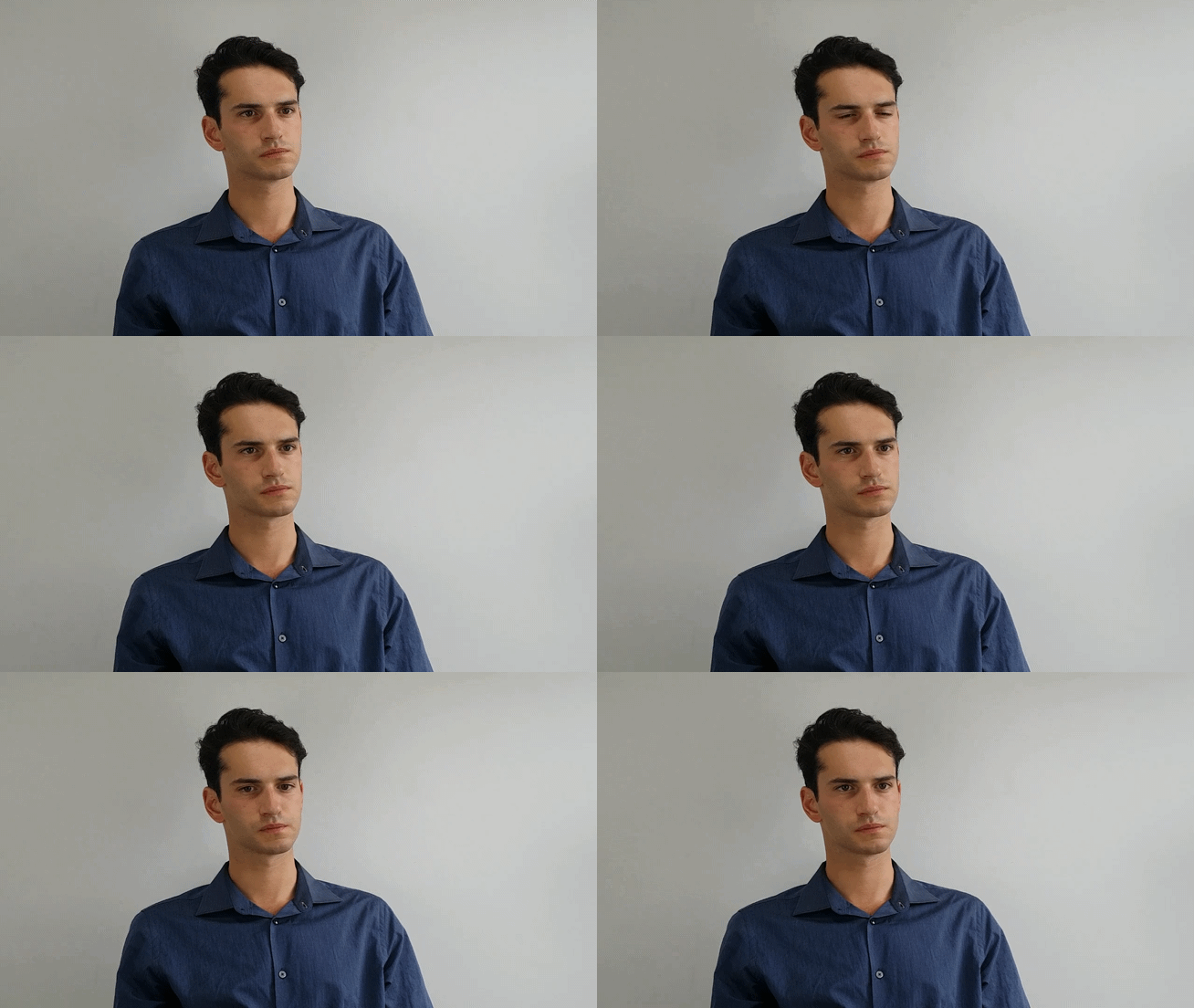
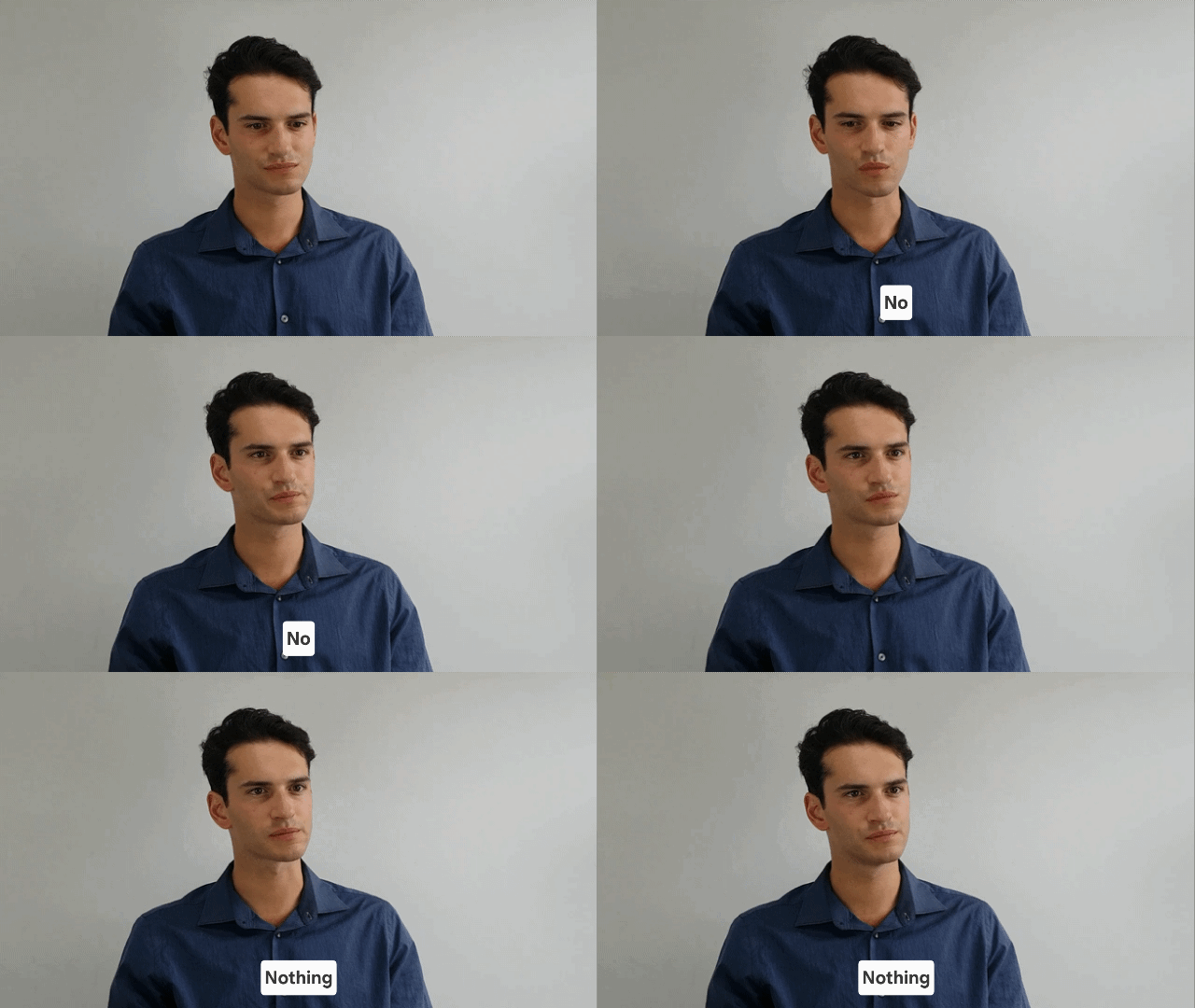
This is a very clear example of an actor suffering from a case of Description Blindness.
Description Blindness:
Not being able to see past the character description
- East Coast American accent.
- Intelligent in an engineering kind of way
- Clean cut, fresh faced, in a Brooks Brothers suit, he is square, disciplined and punctilious.
- Aristocratic
- Deeply moral, deeply idealistic
I read these and thought, right, that’s what they’re looking for – someone like that.
I’m going to be that guy.
And I’m going to friggin nail it.
So I spent 5 days trying to become those adjectives.
I walked around listening to JFK nonstop. I spent 6 hours googling what punctilious meant. I tried to order coffee in a deeply moral, deeply idealistic way.
And I completely forgot to look at what was really going on in the scene.
This resulted in some fairly big mistakes:
- No life behind the eyes – Focused on being the description instead of what Thomas wanted from Alfred in the scene
- Not listening – Waiting for my cue instead of actually hearing and reacting to what my scene partner was saying
- Accent killed everything – Focussing on my East Coast accent so hard it sucked all spontaneity out of the performance
- No journey – Played one flat note throughout instead of mapping where he’s at at the beginning of the scene compared to the end.
- Stiff, wooden, rehearsed – Partial memorisation – not automatic enough to flow, not fresh enough to be spontaneous
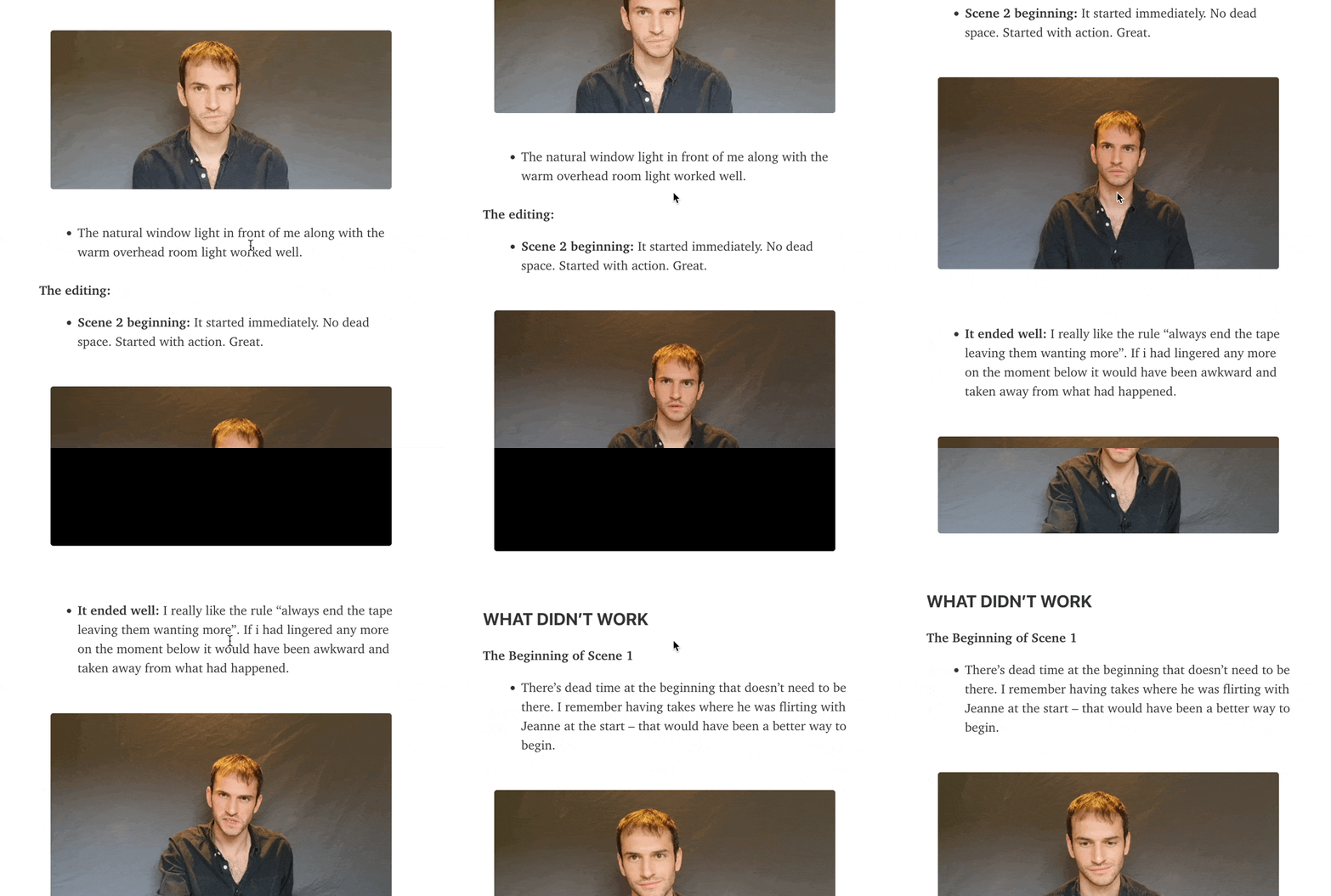
- White background – Plain white wall with no depth looked flat on camera.
- Microphone balance – Too quiet compared to my reader, which drew attention away from me
The result: An impersonation, a stick figure with no life behind the eyes. Stiff. Wooden. Not listening. No journey. One flat boring note from start to finish.
THE BIG TAKEAWAY
Stop spending time on things that don’t matter.
What doesn’t matter:
- Nailing technical requirements at the cost of everything else
- Memorising lines (use the Brando)
Start by focussing on what does matter:
Bringing life to your work. Whatever method you usually use to do that, do that.
For me that’s about figuring out the character’s wants (what are they trying to get from the other character), needs (what do they need to learn by the end), what winning and losing looks like, where they start in the scene and where they end, and what the game of the scene is. Then I’ll pull from moments from where I’m at in my life.
I have learned over years of trial and error that this is the best way for me to connect with someone’s work. I will still work on an accent. Especially if it’s one I am not confident in. But not at the expense of the work that needs to be done to bring life to a scene. That work comes first.
I’m still experimenting and playing around with different things, but this tape has shown me a huge what not to do – never play a character description.
DID YOU HEAR BACK?
Nada. No callback. No rejection email.
It’s the most common outcome for unsuccessful tapes – you just never hear anything. No feedback, no “thanks but no thanks,”. You send the tape into the void and the void doesn’t respond.
So you won’t always know what went wrong. But I encourage you to look back over your past tapes and think critically about how you could improve them for next time.
IS YOUR TAPE SUFFERING?
So that’s what killed my tape. But I’m not special in the slightest – casting directors see these mistakes constantly.
I wanted to know what actually kills tapes in their eyes, so I spent a few weeks going through interviews, videos, and official guidelines from UK casting directors (BBC, Channel 4, CDG, Spotlight) and US casting directors (Disney, Netflix, HBO, Amazon).
Unsurprisingly, my Pennyworth tape hit around 5 of the Top 10.
Here’s what the CD’s had to say:
Why Is Your Selftape Being Ignored?
1. Poor audio quality
It surprised me how many CDs mentioned this one. But it’s the biggy. Humans literally can’t focus on anything else when the audio is poor.
“Make sure that we can see and hear you clearly. It is honestly the most important thing.“
Emily Brockman CDG (HBO Harry Potter)
“I just want to see your eyes, and I just want to hear you.”
Sophie Holland (The Witcher, Wednesday)
2. Poor lighting/distracting backgrounds
The work you are doing should be the focus – not your background.
“Sometimes I get tapes where the person has a light above them and I can’t see their eyes. The eyes are the most important in some ways.“
Lucinda Syson (Foundation)
“
I personally like it when they just keep it simple. Some people really go to town and practically make the whole film! And then it’s pretty impressive, but it’s not necessarily revealing everything you need to know about the performance.“
“I get really nosy about people’s homes. Sometimes I get to see their washing drying on the radiator… And that’s not a good thing.“
Amy Hubbard CDG (LOTR, Hobbit)
3. Portrait mode (instant rejection)
Filming vertically is a huge tape killer (unless you’ve been specifically asked to do it vertical).
“
The number one piece of advice we hear from casting directors is to always film in landscape format with your camera in a horizontal position.”
“Do it in landscape format, do not do it in portrait format.”
Frank Moiselle (Vikings, Penny Dreadful)
4. Not following instructions
When there are specific instructions for how to label your scenes, how to slate etc it’s an easy professionalism win to follow those instructions (important to note that there is a difference between following formatting instructions (e.g. labelling scenes, where to send the tapes etc) and adhering too rigidly to a character description. Character description is up for interpretation – formatting instructions are not.
“Some offices will refuse to view your audition if you’ve failed to follow their instructions. If you’re not following the most basic instructions, how can they trust you on set?”
Marci Liroff (E.T., Mean Girls)
“Read the casting director’s instructions carefully and thoroughly. Don’t skim read the invitation email.”
Emma Sylvester (Father Brown)
5. Wrong eyeline
Casting directors need to see your eyes – if your eyeline is miles away from the camera it’s the equivalent of being on stage with your back to the audience.
“If your reader is even a few inches too far from the camera, we will not get the full impact of your eyes. The key to a good audition is your eyes. I need to see ’em!”
Marci Liroff
“Pick a point of focus (left/right of camera–not directly down the lens), but don’t end up in profile.”
Lauren Evans (Sex Education)
6. Shaky camera/no tripod
This feels obvious, but I have had times without a tripod and been tempted to go full Paul Greengrass handheld. But amateur unstable footage is unwatchable. Again it takes the focus of you and your work.
Your tape could literally make them ill!”
StageMilk
7. Bad reader/no reader/apps
There still seems to be a lot of push back on recording yourself and leaving space for you to reply. Sometimes it’s incredibly hard to find a reader. But it’s undeniable that reading with yourself on an app creates mechanical pacing and should only be used at the most desperate of times.
“using no reader-in at all is not ideal”
but suggests convincing
“your partner, parent, postman to sit down and feed you the lines”
8. Not listening.
Trying to remember your line/your cue. Thinking about what you’re going to have for dinner. Being in your head with worry/self consciousness, all results in one thing. Not listening. And it’s one of the biggest turn offs.
“The most common pitfall that destroys credibility is when the self-tape-ee makes it all about themselves… for gods sake look like you are listening to what they say, reacting to them.”
Amy Hubbard CDG (LOTR, Hobbit):
9. Generic performances (no bold choices)
As we’ve seen from above the safe, careful, “correct” performance gets ignored. The bold, specific choice puts you in front of a director.
“Will they get this self tape–this performance–anywhere else in the world? If the answer is ‘no,’ then good.”
Erica A. Hart (Black Mirror):
“We’re looking for people who take risks and make specific choices. Generic is forgettable.“
Kerry Barden & Paul Schnee (Spotlight, The Help)
10. Not being off-book
When you have your sides in your hand, you are constantly breaking the scene by looking down at your lines, you’re tempted to read what the other person is saying (trying to find your cue) and you are in a constant state of “What’s my next line”.
This will lead to you feeling like crap about the tape.
But most of the time, being off book in time is near impossible.
That’s why we encourage you to try not learning your lines.
“OFF-BOOK IS ALWAYS BEST”
CDG official guidelines (emphasis in original)
“If you haven’t learned it but [are] looking at the page and trying to remember what it is you’re meant to be doing, it’s not conducive to the best possible audition.”
Nina Gold (Conclave, Game of Thrones)
Resources for You
To make sure you never make these mistakes again I made this Unignorable Selftape Checklist:
And if you still have questions about what kit you should be using -here is the equipment I use.
Remember,
What you are doing is incredible. It’s not a normal thing.
You are putting yourself out on the line everyday, risking failure, in order to pursue a higher calling. It may feel like things are a constant uphill struggle. But they will get better. They always do.
Keep going.
Well fucking done.
This is the last week we are doing Selftape Pizza, I would love to hear your thoughts. If you would be happy answering a 2 min questionnaire about it, with a chance to win an Audiobook course worth £299 fill in the poll below.
Alternatively, just reply to this email with any thoughts you have.
Thanks for reading.
See you next week x


Pingback: ⚡️51,299 People Playing Musical Chairs - 6 figure actor - A Newsletter for Actors