share the online version
You voted to see an actor’s payslip.
Today we’ll do just that.
This is Part 1 of 3 in a series called “Htf do I get paid more?”
Step One: Gaining Clarity
If our goal is to make a sustainable living acting, it stands to reason we should probably know the what, why and how we are being paid.
I didnt have a clue.
For years I mistook, “I don’t want this to be about the money” for “I refuse to take money seriously“.
Like a child, scared of what he might find if he looked under his bed, I just shut my eyes and hoped.
I thought that if I spent time thinking and talking about the money, I would turn into an actor who’s just trying to get rich (aka a hack) and I would feel even more shit when I (inevitably) didn’t make any money.
These are the false money scripts I learnt not to question.
Despite our industry being infamously “businesslike”, the acting industrial complex rarely encourages actors to take a closer look at the money they’re paid.
Instead we are kept fat on the “keep working your craft and networking and work towards getting more lucky” route.
I have yet to find an acting class called “How to make more money from your acting”.
We are made to think that we are powerless to change our pay. That even talking about it is pointless.
These money scripts kept me thinking like an amateur.
I didn’t take myself seriously as a professional.
But when my wife and I began talking about starting a family, I realised something needed to change. I needed to start taking what I was being paid seriously. If I can’t even look at my earnings with clarity, how can I think honestly about increasing them?
Once I understood the mechanisms behind how and why I was being paid, the things i’d felt powerless about started to look like levers I could actually move.
By the end of this you will hopefully have a little deeper understanding of what those levers are.
We can then start looking at how you can move them too.
So
without further ado
lets look at my paycheck:
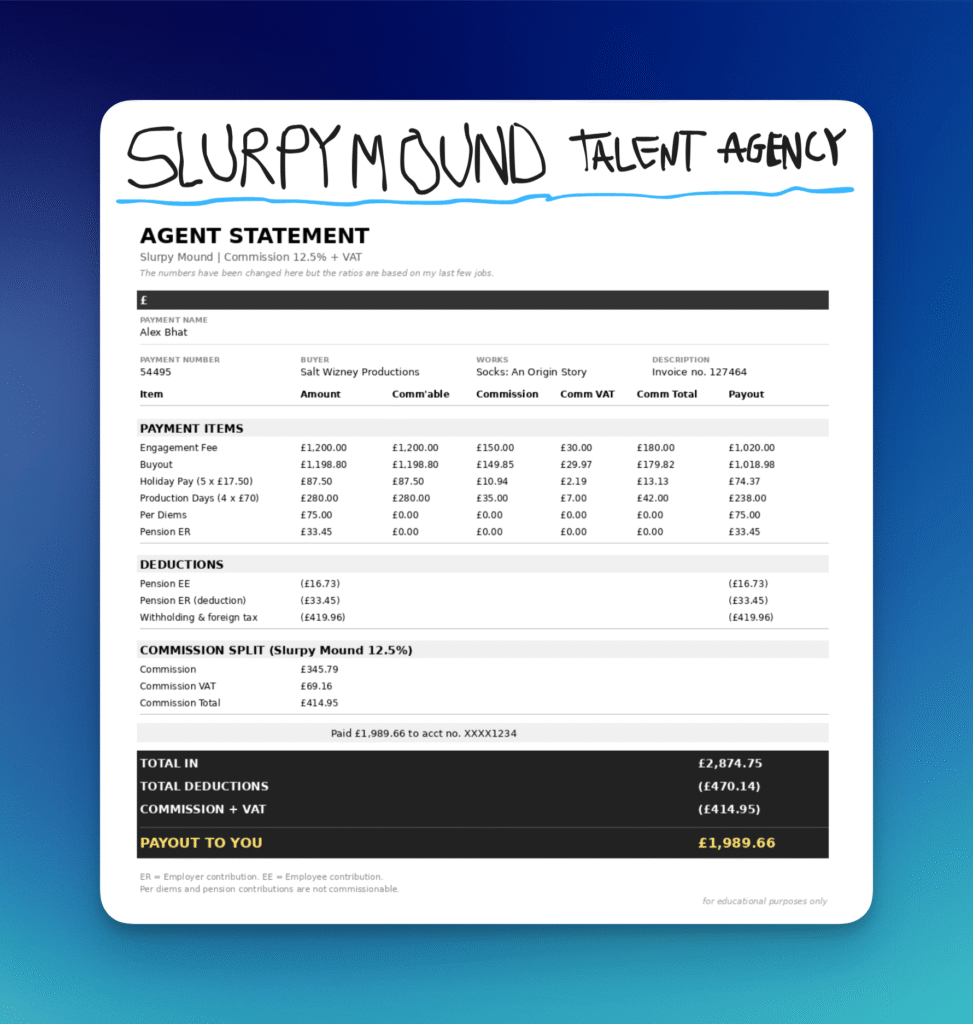
This is an agent statement – it’s what gets emailed to you with details of your pay.
Whilst its not strictly a paycheck in the traditional sense, it’s as close to one as i get.
Because of various nda’s and contractual nonsense a few details have had to be changed:
- Here I am repped by the entirely legitimate and not at all made up agency known as Slurpy Mound.
- Most contracts these days forbid publishing actual numbers (this keeps everyone in the dark and I don’t see a good reason for it) so i’ve had to change my numbers, but importantly, the ratios have stayed the same.
This is a TV payslip. Stage, commercial, voiceovers, fringe, short films, they all pay differently, and some pay better than others for the days worked. I’ll cover the differences between paychecks in a future edition.
So let’s break it down.
WhoTF’S PAYING YOU?
Buyer
This is the production company that pays you. Here, it’s the Salt Wizney company.
Works
The project you’re working on. This is for a part in a tv show about the origin of socks. It’s called Socks: An Origin Story.
Payment Number + Description
These are for your agents mainly. If you have any issues with your invoice you can quote these numbers and they’ll know where to look.
THE PAYSLIP’S COLUMNS
I’ll just wiz through these:
Item
What you’re being paid for
Amount
How much the production company has paid you for each thing.
Comm’able
How much of that money your agent is allowed to take a cut out of
Commission
Your agent’s cut
Comm VAT
Tax on your agent’s cut
Commission total
Total that goes to your agent
Payout
What actually ends up in your bank account.
PAYMENTS (huzzah)
YOUR ENGAGEMENT FEE
This is the headline number on your contract. It’s the fee that the production company agrees to pay you, per week, for your work. A one week shoot earns you one engagement fee. A 6 week shoot earns you six.
Why this matters:
Your engagement fee is the main number that your agents negotiate – they want your engagement fee to be as high as possible (more money for you, more commission for them) but the producers will be looking to keep their costs as low. A veritable battle of wills.
Nearly everything else gets calculated from what your engagement fee is. Raise your engagement fee and you raise everything downstream.
Is there a minimum engagement fee?
Yes. PACT (the producers union) and Equity negotiated the 2026 minimum fee to £635.50 a week. Because there are far more actors than jobs, if there wasn’t a minimum everything would race down to £0. The union won this fight years ago and they keep working to raise it.
So what gets you above minimum?
Experience, profile, the demand for you specifically (for more on this check out the Jason Statham edition) and the production’s budget. Two actors on the same show can have very different engagement fees – one can get equity minimum whilst the other gets millions.
Note about the Equity Minimum.
It only applies to productions signed up to an Equity agreement. Independent films, shorts, low budget productions and student films often are not on these contracts. They can legally offer below the minimum.
YOUR BUYOUT
This is a one-off payment so the production can keep the future rights to distribute your performance wherever they want. (E.g. Uk broadcast tv, streamers, rest-of-the-world tv etc)
Why?
Producers want certainty. They want to know how much you’re going to cost them, upfront. They pay you once and then don’t have to pay you again if the show is a success and is purchased again. This way they can charge channels less, or ensure more profit ends up with them.
Why does this hurt actors?
It used to be that every repeat of a show you were in, every foreign sale (where the show get’s bought by, say, a French channel), every license fee sold, you would be paid again. This used to make up 40% of an actors income. But now royalties make up just 13%.
Fun fact: You won’t be able to find Westworld on HBO Max anymore, even though HBO made it. It cost too much to pay the famous actor’s their royalties, so the producers recently binned it.
HOLIDAY PAY
Every worker in the UK is entitled to 5.6 weeks of paid holiday leave a year. That works out to around 12% of your working time. On short jobs, instead of giving us paid days off, production adds it to our pay instead.
Why?
It turns out workers without paid leave burn out, get sick or get accidental. The law in the UK treats paid leave as your right to public health, so in the same way you have a legal right to the NHS, you have a legal right to have a holiday.
PRODUCTION DAYS
Production Days are what you get paid on the days you literally go in to work. This stops productions being able to call you in for a costume fitting, make up test, or a stunt rehearsal as a free “favour”.
Why a separate rate?
PACT and Equity negotiated a day rate (£70 in 2026) so that calling you in to work has a price. They can’t just do it willy nilly.
PER DIEMS
Ah per diems. The daily spending money production gives you for being away from home.
Why?
When you’re away everything generally costs more than at home (e.g. you might not have to buy food out, you might have to take taxi’s etc).
It used to be an envelope of cash, but now I think for the most part it goes through your agent.
Are they taxed?
In theory they should be tax-free but the rules here are messy. To be safe I’d treat mine as taxable income and put 25% into my tax account.
Agent commission?
No there should be absolutely no commission taken from your per diems (nor your pension contribution.) If Slurpy Mound is commissioning your per diems, tell them to:
PENSION ER
Pension ER (EmployeR Contribution): the production company’s contribution to your retirement fund (aka pension).
As you can see Salt Wizney has made a contribution of £33.45 towards the retirement fund.
How come?
The LAW. If you earn over a certain amount* every employer must put an additional 3% of qualifying earnings into your pension (many productions pay more than the minimum.)
*(£768 over 4 weeks)
Where does it go?
MUOY IMPORTANTO:
This pension money goes into a scheme the production company has set up. Generally, either NEST or The Peoples Pension.
If you are on the Equity Pension Scheme – your pension will still go to the production company scheme by default.
So, if you have an Equity Pension, make sure your agents know your Equity Pension number and they tell production to direct their contributions there.
Being on an Equity pension often means production will have to pay more into your pension than if you weren’t signed up to it but You must remember to tell production.
Other wise you end up with less money and pensions all over the bloody shop.
DEDUCTIONS (boo)
PENSION EE
Pension EE (EmployeE Contribution): This is how much you pay into your pension from your pay. It’s taken automatically.
Why?
Auto-enrolment forces you to save for your pension, meaning more people will retire with money. You can opt out if you want, but you must choose to. And future you, still hustling for work at 89, might be a little pissed.
PENSION ER (deduction version)
You’re keen eyed so you will notice that this is the same EmployeR contribution that came in to your account. It comes in and then goes straight back out into your pension.
Why bother showing it?
Bookkeeping. You get to see everything coming in and out, even if you never touch it. It will also be useful info come tax time.
WITHHOLDING & FOREIGN TAX
If you worked in a different country, chances are that country will tax you.
Why?
Every country taxes any income earned inside it’s borders. Filmed in Hungary? you can be sure as shit Hungary will tax that work.
But
The UK will not tax you again for it. They have double-taxation treaties in most filming countries. Which means you can claim a chunk of it back through your self assessment. (click here for some fun little helpsheets)
COMMISSION
Your agent works on commission. This means when you are not working, they are not earning. As we all know there are pros and cons to this structure.
Pro: it means they are by and large highly incentivised to get you work.
Con: this leaves us feeling very on the hook if we are not making them money.
Why VAT on top?
UK businesses must charge VAT on services. VAT goes to HMRC.
For Acting jobs most agencies charge 12.5%. Smaller ones sometimes charge 10%.
The commission you pay your agent is tax deductible, meaning you won’t need to pay tax on that portion of money.
WHAT YOU FINALLY GET PAID
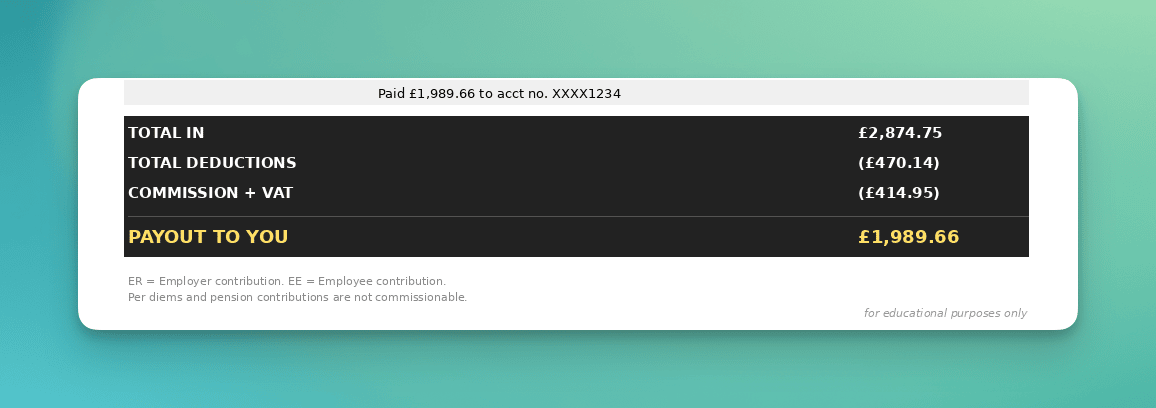
Total In
How much the production company paid you for your work.
Total Deductions
What got taken off that pay, before it reached you.
Commission + VAT
What you paid your agent.
Payout to you
The total that arrives in your account.
As you can see here around about 69% of what you are paid lands in your account.
Once I’ve accounted for tax, I can expect to have around 50% of what the TOTAL IN number is to pay my bills.
So as a rough rule, if my agent says I’ll make £1000 in total from a gig, I plan around £500.
THE TAKEAWAY
From the engagement fee (£1,200) we have brought in £2,874.75. Almost every other line is calculated from the EF.
If we raise our engagement fee by 10% everything else get’s raised: Buyout, holiday pay, production days and pension.
The engagement fee is a huge lever.
Move that and everything else shifts too.
And that’s exactly what we are going to look at in Step 2 of the “How do I get paid more?” series.
I’m working on it at the moment and it should be published in the next few weeks.
Know an actor who loves their art and also can’t find a “How to make more money as an actor” class?
Send them this newsletter:
sixfigureactor.net
pay it forward
YOU
Over the next week, have a think about your relationship with your art and money.
What are your money scripts that have been left unquestioned?
Do you think they are true?
And if I got anything wrong in this breakdown, or missed something important, please let me know. No reply is a silly reply.
Have a great weekend.
share the online version