(We are doing something slightly different this week. If you missed last weeks email you can find it here.)
For the next 3 weeks, we’re going to dig deep into Selftapes.
6 Figure Actor is free and will always be free.
But I’m working on something new.
A paid newsletter about how to make Selftapes that don’t feel hollow, don’t make you feel worthless, and that book you jobs that excite you.
All without needing to learn your lines.
It’s called Selftape Pizza.
Over the next 3 weeks I’ll be sending you – the technique I use to book work (Disney, HBO, Starz), breakdowns of tapes that worked (and failed), and the reasons why UK casting directors are rejecting your tapes.
If you hate it, no worries. Normal service resumes Week 4.
If it’s up your street and you want more, I’ll be launching after Christmas at £6.99/month.
But right now it’s a work in progress and I’m just looking for your feedback.
Here’s what’s coming up:
This week: Download the method that lets you make tapes that book work without memorising a single line (and which Oscar winner it’s named after)
Next week: The exact tape that booked me a Canal+/BBC series regular. I’ll show you the brief, the choices I made, what worked, what didn’t, and the equipment I used (nothing fancy)
Week 3: A tape that completely failed – what went wrong, what I’ll never do again, and the top 10 mistakes UK casting directors will reject tapes for.
At the end of Week 3, I’d love your feedback to make sure this actually helps actors.
Honest answers help – even “this didn’t work for me because…” is useful. I want to build something that helps you get more work. I don’t want it to be another shitty casting workshop that doesn’t move the needle for you.
Everyone who gives feedback will get a discounted Founders price.
Alright. Let’s jump in.
This is the Dream
You haven’t had a tape in weeks.
It’s Friday night, 5.47pm.
An email comes through.
Your heart starts pounding.
Selftape.
Great role in a new BBC drama.
You do a little dance and then-
2 scenes. 5 pages of heavy dialogue.
Due: Monday afternoon.
You panic a little.
Goodbye weekend.
But…
THIS IS THE DREAM.
So
you cancel dinner plans with your partner.
You cancel a bartending shift even though you can’t afford to
you have another tense conversation with your manager. His patience is running thin.
BBC drama, you remind yourself
you won’t have to bartend ever again.
learn those lines…
You leave early from your best mate’s birthday. There’ll always be another.
You must learn those lines.
Work hard work hard work hard.
It will pay off (you whisper into your mirror)
Saturday and Sunday you’re pacing around your flat, script in hand, forcing the words into your brain quicker than they can get out.
Script analysis?
No time. Barely time to read the script
Off book. Off book. Off book.
It will pay off (you whisper into your wall)
Sunday night, you’re shattered.
You’ve barely seen your partner, third weekend in a row but you’re sure they’ll understand.
You’re dedicated to your art. Things will change after you get your break.
You’re sure of it.
That’s what you’ve been told. Work harder than everyone else.
Live the dream.
Do the work.
Earn the role.
It’s Sunday Night.
You tell yourself that you know your lines.
But you know that’s not true.
There wasn’t enough time.
But you’ve worked as hard as you could.
And that should be enough.
…
Here comes Monday.
Set up to film.
Scene partner arrives. A mate you’ve roped in. They’ve given up time. Much appreciated.
You start recording.
First scene.
Mind goes blank.
Embarrassing.
Okay no problem. No problem. New take.
Fuck.
Stumble after stumble, trying desperately to remember what comes next.
Your scene partner is patient, but you know what they’re thinking… because it’s what you’re thinking:
Why haven’t I bloody learnt this
Time is slipping away. They have to go meet their Mum. Hard deadline increases panic. Sweating now. You haven’t got one usable take. You look like an idiot. You feel like shit.
Take 17, no more acting.
Damage control.
Get.
The.
Lines.
Right.
You.
arsehole.
A director of futures past whisper in your ear:
“Your ONE job, your one bloody job, is to say the correct words in the right order, can you do that?! (to the script supervisor) This guy’s fucking ruining my film.”
If you can’t get the lines right – are you even an actor? are you even a person?
they lied to you. there is a right answer. and your getting it wrong.
bye bye creativity. hello dead eyes.
Your mind is screaming at you YOURE BLOWING YOUR DREAM
You take a breath, your eyes linger on nothing in particular, you’re quiet, but your mind is on fire, you are well and truly stuck in your head now –
why do I feel this way? (you whisper into the void)
because you’re shit (the void whispers back)
Friend: Mate, you alright?
You call it quits, you have to, your friendship depends on it. Your mental health depends on it. You force yourself to finally send in a tape. The one where you got most of the lines right. But it’s nothing like you imagined in your head. You nailed the part in your head. But watching yourself back?
You definitely wouldn’t cast you.
Better to send in nonsense than to admit to your agent you struggled as much as you did. It’s not good. You know it’s not. In fact it’s a bloody disaster. You cancelled your weekend for it. You lost money for it. You spent hours on it. You worked as hard as you could. And this was the best you could come up with?
You feel crap. Your confidence is in the gutter. Maybe it’s time to throw in the towel.
And then another email comes through.
Selftape.
2 scenes. 5 pages.
Due Tomorrow.
It never rains…
You know you should feel pumped.
But your heart sinks.
This is not why you became an actor.
Not even close.
THIS IS NOT THE DREAM.
Our best work happens once we know our lines inside out and back to front.
That’s how we get to the place of escape.
The place where you and the writing fuse to form something that has never been done before, never been seen before.
This is your art. This is where you thrive.
But the lines must be deep.
Tom Hanks said it best:
“When you are no longer thinking about the dialogue as dialogue… when you know it as well as you know your favourite song that you’ve been singing since you were 13, there is a freedom of just starting, and it takes you wherever it is that you go.”
But that place is impossible to get to with the short turnarounds we are given for selftapes.
That is why taping feels so dissatisfying.
Learn 10 pages of dialogue.
Read and analyse the script.
Make bold choices.
Find someone willing to give up 1.5 hours of the day.
Make them come to you.
Pay through the nose for a reader if you have to.
Set up a film studio where you live.
Do you have good lighting, sound and camera?
Buy it if you have to.
Adhere to our strict guidelines exactly.
Be grateful. you’re lucky to be taping for this.
You have 48 hours.
No excuses.
Go.
No matter how much we object, Producers instructing the Casting Directors instructing us are unable to give us more than a few days to come up with something they take weeks and weeks and weeks to reject.
A few days is not nearly enough time to learn deeply.
A few days is not nearly enough time to do the work we need to do.
Especially when you are factoring in other things, like paying rent, like childcare, like life.
But.
What happens?
We tell ourselves it must be possible-
“
“Everyone else seems to be able to do it, so why can’t I?”.
It’s not because you are broken:
Everyone else is thinking the same thing.
This is the way things are → but others are doing it → so I must be broken → I’ll suck it up because → This is the way things are…
Which guarantees you’ll feel shit when you do the tape.
And round and round it goes. The whirly gig of a broken industry.
They know what they’re asking for is near impossible.
But they’ve got 200 other actors willing to cancel their lives and send mediocre tapes just to stay in the running. There is no incentive for them to change.
As a result we are all stuck on a treadmill that isn’t slowing down any time soon.
The goal of Selftape Pizza is to help you off that treadmill.
Not just by helping you improve the quality of your tapes. Not just by helping you book more work.
But by helping you get satisfaction from taping, to help you feel proud of the work you do, to help you see improvements, to iterate Moneyball-style, to arrive at a place where you are feeling creative in your tapes, to help you take risks, to help you make bold choices, to help you fail better.
Your tapes should never feel like they have been for nothing. You should always feel like you have made something worthwhile. You are building a library of work you can be proud of.
We believe that your selftapes are your art.
For most of us, selftapes are our acting. If we’re lucky, we work 3 months in a year. The rest is waiting and taping.
So if we hate selftapes, we end up hating the work.
We become jaded.
And if we are jaded, then what is the point of all this unemployment?
What if you could have fun making tapes instead?
What if you could feel ready and prepared for when a big one arrives.
You’re not desperately Youtubing “Actor selftape lighting tips” minutes before you tape.
Where you feel like you’re constantly improving week in, week out.
Where you finally feel comfortable to play on camera.
You send the tape not just confident you could play the part well, but you know no one else could play it like you could. What you have come up with is truly unique.
You have made something that is a true expression of you.
This is the dream.
You haven’t taped in weeks.
Friday: 5.47pm.
email comes through.
Self Tape.
Lead in a BBC drama.
You do a little dance
2 scenes. 5 pages of heavy dialogue.
Due: Monday afternoon.
You’re ready for it.
You text your taping partner. They’re free Monday morn. Terrific.
You open a Google Doc. Fifteen minutes later, you’ve done everything you need. No lines to learn. Work done.
You have a great dinner with your partner.
You are able to work your shift. (rent’s covered)
Sunday afternoon, you sit down with the script. You read it. Research. Wants and Needs. Bold choices. Whatever works for you. Work that adds.
And here comes Monday morning.
Your partner shows up. You start recording.
You’re listening. Experimenting. Trying things out.
Take 3 is mad. Take 5 you’re unexpectedly in tears. Take 7 your done. You know you’ve made something special.
You watch them back. You have 2 favourites.
Not the two where you got the words right (you got the words right in all of them). The two that excite you most.
They’re both great. You pick the one that’s riskiest. The one no one else but you could have possibly done.
You send it off.
You feel great. You’ve made something special. No matter the outcome, you’ve made something you are proud of. Fuck the outcome.
Another email comes through.
Self tape.
2 scenes. 5 pages.
Due: Tomorrow.
You smile.
This is what selftaping should feel like.
Why Does Memorisation Kill Your Tapes?
When you’ve got 2-5 days to learn lines, you end up in the “no man’s land of memorisation”. You may be able to muddle your way through a scene. But there is no way you can inhabit it, enjoy it, find flow.
There’s data that backs this up.
Research on learning curves, cognitive load, and automaticity shows why your brain gets stuck in that middle ground. Where performance goes to die.
Here’s what’s happening: your brain is trying to do four things at once:
- Remember what comes next (retrieval)
- Check if you got it right (monitoring)
- Manage the panic about forgetting (anxiety)
- Responding to the other person (acting)
Something must be sacrificed. And it’s always the last thing on that list, the acting. It’s why your performance may come out self-conscious, stiff and not at all what you had in your mind. Because your mind was putting out fires everywhere.
The research shows optimal performance happens at two extremes:
Complete automaticity – lines learnt so deeply you could recite them in your sleep (like your phone number). This takes weeks, sometimes months. You don’t have weeks.
Fresh, present-moment engagement – sight-reading, cold reading, improvisation. You’re not trying to remember anything. You’re just responding to what’s happening right now.
The system is rigged against you. You can’t hit automaticity. You don’t have time.
But you can stay fresh and present. And that’s what this method does.
The Brando*
The solution is simple:
Stop learning your lines.
The following method lets you self-tape without memorising a single word. You write out your lines in a specific way that turns them into a teleprompter of sorts. Your brain becomes free to listen, respond, and make bold choices – all without the “what’s my next line?” panic.
The method has two parts:
Part 1: Script Prep (the Brando)
Part 2: Your Partner
You need someone who enjoys the work. Someone who gets satisfaction from workshopping scenes with you, who you can do the same for when they need it. Someone who gets it.
Where to find them:
Look for actors who feel similarly about the broken system. Who are also unnecessarily bending themselves into unnatural shapes to accommodate a shitty industry, who also want to feel better about their tapes, who also want to work smarter.
Forward them this email.
See if they want to try this with you.
Who to look for:
- Someone who’ll muck about with you – try things, fail, laugh when you fuck it up
- Someone who’s up for helping you when you ask “How can we make it better?”
- Someone you trust
- Someone you enjoy spending time with
- Someone available
Who to avoid:
- People who don’t want to be there
- People who direct you without your permission
You’re not finding a reader. You’re finding a creative partner. Someone to support you and for you to support.
*Why it’s called the Brando.
This technique is named after Marlon Brando, who read his lines in a similar way for The Godfather and won an Oscar for it. More on that in a second.
But Does It Actually Work?
I used to be that actor:
It takes me ages to learn lines. I cancelled a lot of my life for the job. I bought into the notion that that was what being an actor was. I must sacrifice my life because casting only have 3 days to cast this part…that’s just the way things are.
So I’d spend much wasted time desperately drilling lines. Feeling like a failure when my mind went blank on take 1. Sending in tapes I knew were crap because I’d run out of time or had just lost the will.
But then I began working smarter.
It started out of necessity – there was no way to learn 10 pages overnight.
But then it turned into a technique that allows me to make choices that i wouldn’t be able to if i was constantly thinking “what’s my next line”
I’ve now booked 8 jobs using the Brando – Disney, HBO, Starz, Amazon, Channel 4, PBS, BBC. Including series regular roles on Marie Antoinette (we’ll look at that tape next week) and a new Channel 4 comedy (we’ll look at that one when the show comes out next year)
For Marie Antoinette I used the Brando. Sent in the tape. And they offered me the job off of that.
(the channel 4 one got me in front of the director)
Over 20 callbacks from tapes where I didn’t memorise a single line.
The method works.
But what’s most valuable about this method is not the jobs.
It’s that I no longer feel like shit when I tape.
I now feel creative.
I now look forward to the tape.
YOU MAY HAVE SOME VERY REASONABLE QUESTIONS:
1. “Isn’t this cheating?”
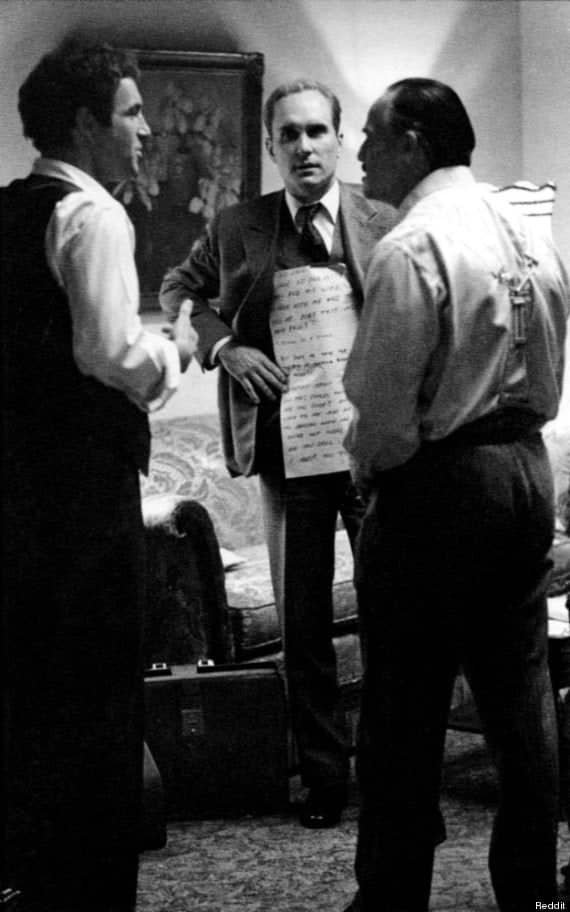
Marlon Brando on the Godfather.
He used cue cards for his work. Insisted on it. Not out of (as is widely believed) laziness. But because he was experimenting with his craft:
“In ordinary life, people seldom know exactly what they’re going to say when they open their mouths and start to express a thought. They’re still thinking, and the fact that they are looking for words shows on their faces.”
He believed rote memorisation sounded like “Mary Had A Little Lamb” to his ear. Rehearsed. Fake. Dead.
So he used cue cards to create spontaneity. Searching for his words in the moment.
“If you don’t know what the words are but you have a general idea of what they are, then you look at the cue card and it gives you the feeling to the viewer, hopefully, that the person is really searching for what he is going to say—that he doesn’t know what to say.”
This is technique.
And the cast supported it. Yes, because it was Brando, but also because it worked.
Robert Duvall said:
“It was part of the game, part of the fun. Listen, that’s the way he works… You can do that for spontaneity to keep it fresh, to be always searching.”
They were serious about the work. But playful with each other.
History tells us how his experiment worked out:
The film was the film, he won the Best Actor Oscar and he turned in one of the most iconic performances in cinema history. With the help of his cast mates.
But, in order for the technique to be useful to you, you must decide for yourself.
Watch his performance.
Is he cheating?
2. “I need to see the other person in order to react off of them”
Do you?
Very quickly you will realise this technique makes you to listen, and you start listening very hard, because your cue isn’t on the sheet, you are forced to really listen to what they are saying and what they are doing.
You hear them shift in their seat. You hear their smile on the line. You hear their weighted pause before the storm.
3. “Will they see my eyes scanning across the page?”
Once you have done a few tapes you will realise that no, the method actually simulates how we look at people when we talk. Once in a while a line will be too long and you will catch yourself moving from left to right unnaturally.
If you spot this occurring, slow down, take a breath at a comma. Most issues can be solved by not rushing through the line.
4. “Won’t casting directors/agents get angry at me for doing it this way?”
You are the artist. You get to decide how to make your selftapes. If you turn in a cracking tape before the deadline, who gives a shit.
Lot’s of actors already use this technique, but most are a little worried about the decision makers finding out.
We believe they shouldn’t be. This is a legitimate technique. And one that is necessary until the too quick deadline culture changes.
5. “What if the casting asks me to do it again without the script in a callback?”
At this point a few things have happened:
- They have given you the green light:
“We love what you are doing”
This provides you a heap of confidence going into your callback – the choices you made from your tape were good, you are for all intents and purposes right for the role, the role is yours for the taking. You should feel confident.
- That confidence will bleed into your learning, it’s much harder to learn lines when you have self doubt and unclear choices rattling around your head. It’s much easier to learn once you have a clearer direction to follow (e.g. the choices you found from your 1st tape workshop).
- The lines will have embedded themselves relatively deeply from the actual act of doing the tape and workshopping with your partner. They have essentially been par-cooked, and all you need to do is finish them off.
Try It on Your Next Tape
Even if you’re sceptical, just try using it on one scene. It takes 15 minutes. See what happens when you’re not stuck thinking “what’s my next line.”
Find your collaborator. Someone you trust. Someone who feels similarly about the too short turnarounds and broken system. Someone who’ll enjoy workshopping with you, who you can do the same with when they need it. Forward them this email.
Next week, I’m breaking down the tape that booked me a series regular role on Marie Antoinette (Canal+/BBC). You’ll see how I used the Brando, the exact choices I made, what worked, what didn’t, was the tape even good? The mistakes I made, and the equipment I used (nothing fancy).
Once you’ve used the Brando, reply to this email and tell me how it went. What surprised you? What felt different? What questions came up?
See you next week,
Ax


Pingback: 🌋 “That Got You A Series Reg…Really?” - 6 figure actor - A Newsletter for Actors
Pingback: Your Selftapes = Binned 🗑️ - 6 figure actor - A Newsletter for Actors